
Marketing Is a Form of Hypnosis
Marketing works by narrowing attention. It lights one part of the stage so brightly that everything outside the beam becomes difficult to see.
Consumer brands do it with color, music, status, urgency, and aspiration. Enterprise technology vendors use a more respectable-looking toolkit: analyst quadrants, keynote stages, customer logos, architecture diagrams, acronyms, roadmaps, and the word platform.
Corporate buyers like to believe they are immune. They have RFPs, procurement departments, architects, security reviews, committees, and spreadsheets with weighted criteria. But corporate users are no more rational than ordinary consumers. They simply conceal the same emotions—fear, prestige, familiarity, career risk, and fear of missing out—behind professional vocabulary.
A buying committee is still a room full of human nervous systems.
Under conference lighting, every roadmap looks inevitable. Every dashboard appears complete. Every integration seems seamless. Then the fluorescent, almost acid-colored distortion begins to fade. Sometimes the product underneath is genuinely strong. Sometimes the bright shell hides immature features, shallow integrations, operational compromises, or simply less substance than the campaign implied.
This does not mean that marketing is always a lie. It means that marketing is never evidence by itself.
That is the useful way to read Pure Storage’s twelve consecutive appearances as a Leader in Gartner storage Magic Quadrants: not as an award, not as proof of universal superiority, and certainly not as a reason to stop asking questions. It is a long-running market signal—one that deserves attention precisely because maintaining architectural and commercial relevance over twelve years is much harder than producing one impressive launch.
The record was earned under the Pure Storage name. The company adopted the Everpure name in February 2026; the rebrand does not retroactively change the history, but it does raise a useful question about whether the broader new identity will be matched by equally mature capabilities beyond storage.
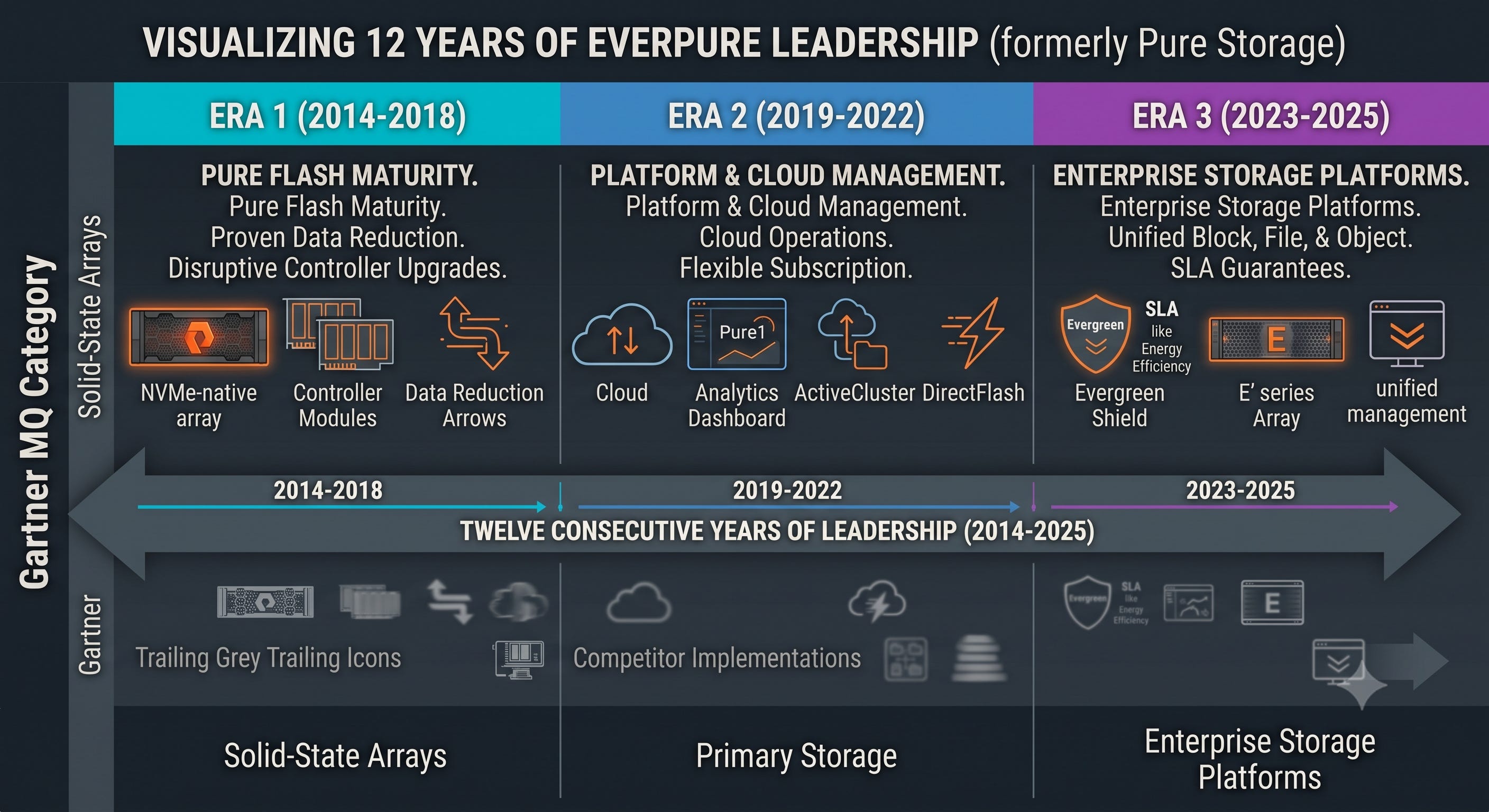
What Twelve Years Actually Prove
In 2014, the decisive storage question was comparatively narrow: could an all-flash array deliver enterprise reliability, predictable latency, usable data reduction, and manageable economics?
By 2019, Gartner had replaced its separate Solid-State Arrays and General-Purpose Disk Arrays reports with a broader Magic Quadrant for Primary Storage. The market was no longer judging flash as an isolated hardware category. Buyers increasingly expected software-defined operations, automation, cloud connectivity, flexible consumption, and support for a wider range of workloads.
By 2025, the category had expanded again into Enterprise Storage Platforms, covering block, file, and object storage across structured and unstructured data. The center of gravity had moved from the array to the platform: common management, fleet-wide visibility, cyber resilience, service-level commitments, and a consistent operating model across environments.
Surviving those category changes matters. A vendor can optimize a launch for one analyst cycle. It is harder to remain relevant while the object being evaluated changes from a flash appliance into an enterprise data platform.
But twelve years do not prove that every Pure product is best for every workload, that every feature is equally mature, or that the company should win every procurement. A quadrant describes a vendor’s position in a market. It does not reproduce your architecture, your team’s skills, your migration risks, your contract, or the failure modes that will appear at 03:00 on a Sunday.
The Three Eras Behind the Run
1. The all-flash challenge: 2014–2018
Pure Storage’s early advantage was not simply that it sold flash. Several vendors could put SSDs into an array. The more consequential proposition was an operating model built around flash from the beginning: data reduction, simplified management, predictable performance, non-disruptive software and hardware evolution, and a commercial promise that storage should not require periodic forklift replacement.
The important innovation was the combination. Hardware architecture, software behavior, support, and lifecycle economics were presented as one system rather than as separate purchases.
That model became Evergreen.
Its strongest idea was psychological as much as technical: customers should not have to fear the next refresh cycle. If controllers could be upgraded without a disruptive data migration, the array stopped behaving like a depreciating island and began to resemble a continuously evolving service.
2. From array to operating model: 2019–2022
As the category broadened into primary storage, raw performance became less differentiating. Flash was no longer exotic. The more useful questions became operational:
Can the platform be managed consistently across a fleet?
Can upgrades happen without a migration project?
Can capacity and performance be consumed more flexibly?
Can the same operational model extend into cloud environments?
Can a small team operate the estate without building a priesthood around it?
Pure’s answer combined Evergreen, cloud-based fleet management through Pure1, automation, subscription models, and an emphasis on simplicity. This was a credible strategic progression: the company did not abandon the architectural idea that built its position; it expanded that idea into a broader consumption and management model.
This is also where scrutiny should increase. The word platform can describe a genuinely coherent control plane—or it can be a marketing ribbon tied around a portfolio of unevenly integrated products. Buyers should test which one they are seeing.
3. Platform promises and service levels: 2023–2025
The latest era is defined less by owning a particular box and more by purchasing an outcome: availability, performance, energy efficiency, recoverability, upgradeability, and a predictable lifecycle.
That shift is real and useful. It also creates new opportunities for marketing hypnosis. A service-level promise can sound absolute on a keynote slide while the contract defines exclusions, measurement windows, customer obligations, and remedies that are far narrower. A guarantee may compensate the customer with service credits without compensating for the operational damage of an outage.
The mature question is therefore not, “Does the vendor offer an SLA?” It is:
What exactly happens—technically, operationally, and contractually—when the promised outcome is not delivered?
Where Pure Storage Genuinely Led
Pure deserves credit for turning non-disruptive lifecycle management from a technical feature into a coherent business model. Evergreen linked controller evolution, software continuity, support, and customer economics in a way that was easy to understand and difficult for incumbent refresh models to ignore.
The subsequent arrival of similar lifecycle programs elsewhere supports two conclusions at the same time.
First, the original idea was influential. NetApp announced its Storage Lifecycle Program in 2023, including non-disruptive controller upgrades for eligible customers. HPE introduced the Timeless Program for Alletra Storage MP in 2024, also centering the offer on non-disruptive controller modernization for qualifying subscriptions.
Second, the category is no longer unique. Once competitors adopt the principle, leadership depends on execution, eligibility rules, architectural limits, support quality, and contract economics—not on who can tell the cleanest origin story.
Calling every later program a “copy” may be emotionally satisfying, but it is analytically weak. Competitors respond to customer demand, technical possibility, and commercial pressure. They also implement similar ideas through different architectures and contractual terms. The buyer’s task is to examine those differences, not applaud the mythology of a single brand.
Where the Bright Shell Can Hide Weakness
No vendor is equally mature across every protocol, workload, integration, and operating environment. A strong block-storage heritage does not automatically guarantee identical depth in file, object, cloud-native, edge, analytics, or AI use cases. A polished common interface does not prove that the underlying services share the same operational behavior.
Likewise:
A non-disruptive controller upgrade does not eliminate capacity planning, migration between architectures, or application-level testing.
A resilience feature does not replace tested recovery procedures and clearly assigned responsibility.
A ransomware narrative does not prove recovery time under your data volumes and dependencies.
A sustainability claim needs a defined baseline, measurement method, and lifecycle boundary.
A subscription can improve flexibility while also introducing term commitments, eligibility conditions, and long-term commercial dependence.
A roadmap is not a delivered feature.
This is the moment when enterprise buyers must surface from the pool of acid-colored distortion. Remove the stage lighting. Ignore the quadrant dot for an hour. Ask the engineers to demonstrate an upgrade, a failure, a restore, a workload spike, and a broken integration. Read the footnotes in the guarantee. Speak to customers whose environments resemble yours—not only to the reference selected by the vendor.
Sometimes the sober view confirms the marketing story. Sometimes it reveals incompleteness or emptiness behind the bright exterior. Both outcomes are valuable, because the purpose of evaluation is not to validate a campaign. It is to discover reality before signing the contract.
What Gartner Can—and Cannot—Tell You
Gartner evaluates vendors against weighted criteria under two broad dimensions: Ability to Execute and Completeness of Vision. That can help buyers build a market map, identify credible suppliers, and understand how the analyst believes the category is evolving.
It should be a starting point, not a purchasing decision.
Gartner itself states that a Magic Quadrant is not intended to be the sole tool for selecting a vendor. Inclusion is not an endorsement, and the familiar four-quadrant graphic is not a league table. A Leader may still be a poor fit for a specific environment; a Challenger, Visionary, or Niche Player may be the stronger choice for a particular workload, geography, operating model, or budget.
The moment a vendor turns a quadrant into a medal, part of the analysis has already been replaced by theater.
Three Questions That Cut Through the Theater
Before treating any storage platform as strategic, ask the vendor to answer three questions with a live demonstration, contractual language, or independently verifiable customer evidence:
Maturity: Are block, file, and object capabilities equally mature for my workloads, or merely available under one brand and interface?
Failure: What happens when availability, performance, efficiency, or recovery commitments are missed—and what exclusions apply?
Economics: What is included for the full term, what requires a new purchase, and how do renewal, capacity growth, and exit costs change the TCO?
If the answer is another slide deck, the answer is incomplete.
The Sober Conclusion
Pure Storage’s twelve-year run is meaningful. It suggests that the company did more than market a fashionable flash array: its core ideas about simplified operations, non-disruptive evolution, and lifecycle economics continued to matter as Gartner repeatedly widened the category.
That deserves recognition—but not devotion.
The strongest tribute to a genuinely good technology is rigorous scrutiny. Good architecture survives uncomfortable questions. Mature products survive failure testing. Fair commercial models survive a reading of the small print.
Bright marketing can hypnotize a household consumer and an enterprise architecture committee with equal ease. The enterprise version simply has better graphics and a larger budget. Leadership begins when we notice the hypnosis, step outside the color field, and inspect what remains.
Sometimes there is substance.
Sometimes there is an unfinished product behind a perfect campaign.
The quadrant cannot make that distinction for you.
Stay awake. Stay skeptical. Stay naked.
© 2026 Michaił Domalewski / Naked CyberSec. All rights reserved.