
The technology industry loves free competition. Especially when the right companies win.

When a rival starts moving through the stages a little too confidently, there is another option: speak to the companies supplying its motorcycle. Let it keep the frame. The racing colours, too. But engines, electronics and equipment for making replacement components? Those require a separate conversation.
Then carry on explaining your technological superiority.
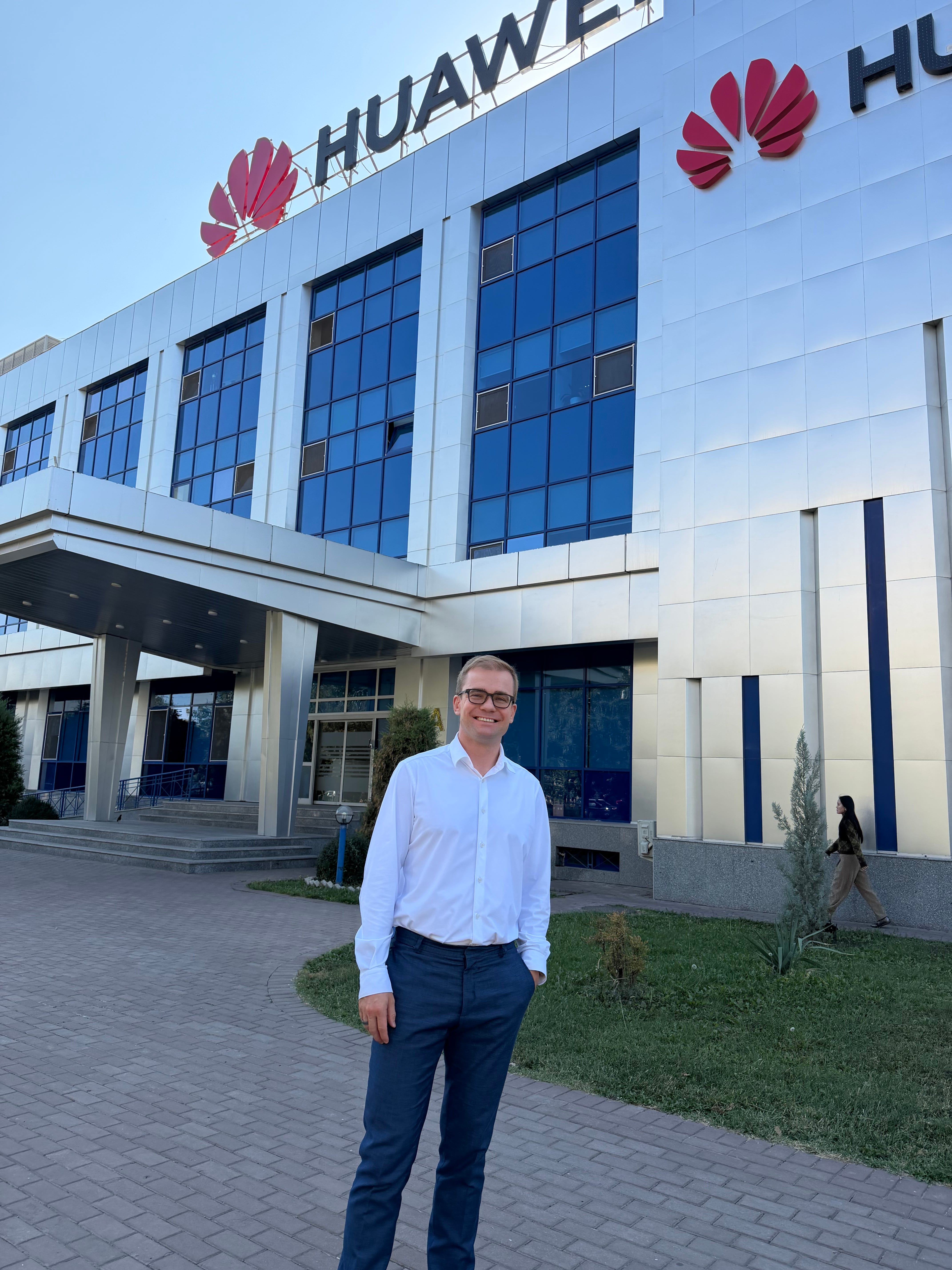
I now work for Huawei. There is my disclosure, before anyone helpfully discovers it for me. But my interest in this story extends beyond the name on my employment contract.
I see Huawei as one of the structural pillars of China’s technology industry: telecommunications, computing, storage, cloud services, processors and software platforms. Pressure on a company operating across that much infrastructure inevitably reaches beyond the company itself.
That is how I interpret the American restrictions: as a deliberate attempt to constrain a central part of China’s technological capacity.
The AI Race Did Not Begin with ChatGPT
In 2019, during Donald Trump’s first presidential term, the United States added Huawei to the Entity List. In 2020, Washington expanded restrictions affecting access to semiconductors manufactured using certain American technologies and equipment. The pressure reached both finished components and the means of producing them. (federalregister.gov, federalregister.gov)
At the time, the public conversation revolved around 5G. Looking back from today’s AI race, the significance of controlling access to computing hardware is even clearer. That does not mean every decision followed a single master plan. It means the strategic value of semiconductors was understood well before chatbots became a household topic.
By 2025, the competition was measurable. According to Stanford’s 2026 AI Index, DeepSeek-R1 briefly matched the leading American model in February 2025. By March 2026, the leading American model’s advantage over its Chinese counterpart was 2.7% on the Arena comparison used in the report.
Meanwhile, private AI investment in 2025 reached $285.9 billion in the United States versus $12.4 billion in China. Private investment is an incomplete picture, particularly given Chinese government funding. Still, the scale of the American money flowing into AI is remarkable. (hai.stanford.edu)
With that much money around, AI has become a cash cow, and everyone wants a turn at the udder: vendors, consultants, analysts, politicians and regulators. Sometimes adding a chat window to an existing product appears to qualify as a historic technological breakthrough.
Real engineering progress continues underneath the noise. Separating the two takes work.
The race itself increasingly reminds me of Paris–Dakar. A spectacular start is useful. So are fuel range, reliability, navigation and a team capable of repairing the motorcycle after a punishing stage.
In computing, electricity is the fuel. Processors, memory and interconnects do the mechanical work. Access to critical components can determine whether you reach the next checkpoint at all.
Kunpeng 950: Building the Engine
This brings me to Kunpeng.
Huawei develops its own Arm-based server processors. For Kunpeng 950, the company announced a maximum configuration of 192 cores and 384 threads per processor, built around its own dual-threaded LinxiCore design. It also announced four-layer security isolation and confidential computing capabilities intended to protect data while it is being processed. (huawei.com)
Those numbers matter because enterprise infrastructure performs many jobs at once. Virtual machines, containers, databases, analytics and cloud services all compete for processing time and memory access. More cores can help, provided the rest of the system keeps them supplied with useful work.
That last condition deserves more attention than it usually gets.
A powerful engine is rather disappointing if the transmission cannot handle it or the fuel supply keeps cutting out. Expensive processor cores can spend their time waiting for data just as effectively as cheaper ones.
Huawei’s approach extends beyond the individual chip. For the Kunpeng 950-based TaiShan 950 SuperPoD, its initial announcement specified up to 16 nodes, 32 processors and 48 TB of memory, with pooling of memory, SSD and DPU resources. Those are system-level figures. (huawei.com)
Populate all 32 processor positions with the announced 192-core variant, and the arithmetic gives 6,144 cores and 12,288 threads. That is a calculation from the published limits, rather than confirmation that every such configuration is commercially available.
The engineering question is how effectively those resources work together. In a conventional cluster, one application can run short of memory while capacity sits unused elsewhere. Moving data between servers also consumes time and resources. Tighter integration and resource pooling offer ways to address those problems.
And this platform has moved beyond a roadmap slide. In September 2026, Digital China introduced its KunTai R722 K3 server based on Kunpeng 950, describing support for SVE2 vector instructions, memory encryption, CCA confidential computing and UnifiedBus connectivity. (digitalchina.com)
For AI infrastructure, the general-purpose CPU still has plenty to do. Data must be collected, read, prepared and delivered. Results must be stored and served. Databases, application services, networking and management software continue working around the model.
Within Huawei’s portfolio, Kunpeng handles general-purpose computing, while Ascend provides specialised AI acceleration. The usefulness of the whole system depends on how well these components work together.
A Processor Needs Somewhere to Work
A customer cannot deploy a semiconductor announcement.
Applications need compatible builds. Libraries need checking. Operations teams need diagnostics, updates and support. Developers need tools that help them identify what will break before the production migration discovers it for them.
Huawei’s broader computing ecosystem includes openEuler, BoostKit libraries and Kunpeng DevKit. The DevKit provides tools for analysing source code and helping migrate applications from x86 Linux to Kunpeng Linux. (hikunpeng.com)
An existing x86 binary does not become an Arm application through enthusiasm. Dependencies, architecture-specific code and vendor support still matter.
This is where a computing platform earns its place. Designing a processor is difficult. Making it useful to customers requires sustained work across the rest of the stack.
For me, that is the significance of Kunpeng: the ability to develop the engine, the supporting systems and the tools needed to keep the motorcycle running.
Apparently, Dependence Works Both Ways
Restricting a rival’s supplies feels comfortable while you assume your own supply chain is secure.
Then China restricted exports of certain rare-earth materials and magnets. Some automotive manufacturers faced shortages, reduced production or temporary shutdowns. (iea.org)
In our rally analogy, this is the moment the team restricting access to engine parts discovers that the rival also controls an important supply of “rubber for the tyres.”
The rubber is metaphorical. The dependence is real.
Global supply chains turned out to be more complicated than the speeches. You can control one critical component and still depend on someone else for another.
My reading is that pressure on Huawei strengthened the incentive to build alternatives. When access to a critical supplier can disappear through a political decision, developing your own capability acquires a very different place in the budget.
Fuel Consumption Counts, Too
My personal laptop has been running on Arm for years. With my pattern of use, I charge it roughly once a week.
Then I received a work laptop with an Intel x86-64 processor, an architecture I used to be very fond of. The hot chassis and frequent search for a socket felt strangely familiar.
This is my experience with two particular devices. Processor implementation, manufacturing process, display, software and workload all affect battery life. A weekly charging routine tells you nothing about continuous runtime without knowing how the laptop is used.
But the practical difference is still there: one machine lets me spend much less time thinking about its charger.
That is what attracts me to well-designed Arm systems: useful work per watt. On a laptop, it becomes battery life and comfort. In a data centre, it enters the electricity bill, cooling requirements and operating costs.
Platform maturity, certifications and a familiar logo all have value. I would still like to know how efficiently the actual system performs my workload.
On a Paris–Dakar stage, I would ask how far the motorcycle travels on a tank, how it behaves under sustained load and how much time it spends being repaired.
A distinguished racing history offers limited comfort beside an overheating engine in the desert.
They Expected the Motorcycle to Stop
Huawei has been heavily restricted in the American market and denied access to important technologies. Did that make the company weaker?
My view is that the pressure also made it more determined to develop its own technology and strengthen its position elsewhere. The cost was substantial. So was the response: Huawei reported spending 21.8% of its revenue on research and development in 2025. (huawei.com)
They tried to push you out of the rally. Restricted the spare parts. Expected to find you stranded somewhere between checkpoints.
You kept going. Rebuilt the motorcycle. Started developing the critical components yourself.
Now they have to race us—and we depend much less on their permission to ride.
© 2026 Michaił Domalewski / Naked CyberSec. All rights reserved.