
The Six Months That Never Happened
On March 14, 2023, OpenAI introduced GPT-4.
Eight days later, on March 22, the Future of Life Institute published an open letter. It called for an immediate pause of at least six months in the training of systems more powerful than GPT-4. The pause was supposed to be public, verifiable, and shared by all major players. If the labs could not agree, the authors wanted governments to impose a moratorium.

At first, more than one thousand people signed the letter. Over time, the number passed 31,000. The signatories included Elon Musk, Steve Wozniak, Yoshua Bengio, Stuart Russell, and other well-known researchers and business leaders.
The letter asked big and uncomfortable questions. Should machines flood our information space with propaganda and lies? Should we automate every job? Should a few unelected technology executives make decisions about the future of civilization?
It sounded serious. Perhaps even historic.
There was no pause. Not even for a day.
Not because the risks had disappeared. And not because anyone had proved that the next generation of models was safe. The pause failed because the letter offered a moral answer to a problem that had already become an economic, technological, and geopolitical race.
Signing the letter cost nothing. A real stop would have cost market share.
Why the Pause Was Doomed
First, the letter created no obligations. There was no regulator, verification process, or penalty. There was not even an accepted way to decide when a system had become “more powerful than GPT-4.”
More powerful at what? Mathematics? Coding? Parameter count? Context length? The ability to hallucinate with confidence during a board meeting?
Second, the people with their hands on the controls did not press the brake. Sam Altman, Sundar Pichai, and Satya Nadella did not sign the letter. The companies with the models, clouds, capital, and computing infrastructure made no shared promise to stop.
Third, this was a classic prisoner’s dilemma. One participant may honestly believe that a pause makes sense. But it cannot know whether its competitors will also stop. A lab that freezes its research alone will not save humanity. It will simply give its competitors a six-month lead.
Fourth, the countdown started after the starting gun had already fired. The models released in the spring and summer of 2023 were already in development. In July, Elon Musk, who had signed the pause letter, publicly launched xAI. Today, its website proudly describes the Colossus cluster with 200,000 GPUs.
We cannot honestly say that every one of these models broke the call not to create a system “more powerful than GPT-4.” The vague definition makes that impossible to prove. But we can say one thing with confidence: the race did not stop for a single day.
During the time that was supposed to be used to create common rules, the market turned generative AI from an experiment into a required part of almost every large technology company’s strategy.
An even more revealing event took place on May 30, 2023. The Center for AI Safety published a short statement on extinction risk. It was signed by Sam Altman, Demis Hassabis, Dario Amodei, Geoffrey Hinton, and Yoshua Bengio. The leaders of major AI labs publicly accepted that AI could create risks on the scale of pandemics and nuclear war. Then they continued the race.
I do not think they were all lying. The conclusion is more uncomfortable: the system was stronger than the personal beliefs of the people inside it. Warning about risk became compatible with moving faster. Safety became a separate workstream, a framework, and a set of presentations. It did not become a brake pedal.
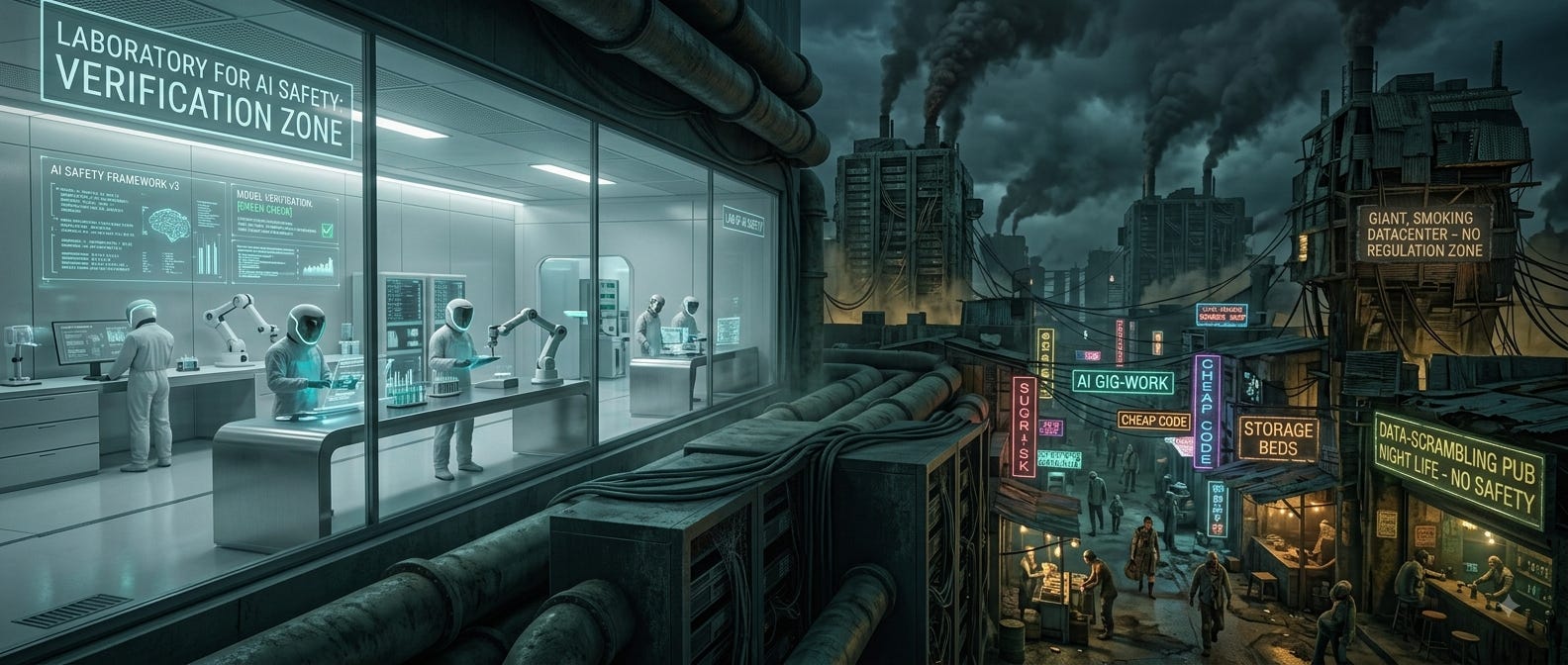
The industry did not ignore safety after the letter. It turned safety into an institution. New teams, committees, frameworks, and budgets appeared. So did a whole job market: alignment researchers, model evaluators, red team engineers, AI governance leads, and safeguards analysts.
In July 2023, OpenAI announced a new Superalignment team. It promised the team 20% of the compute it had secured over four years and openly recruited new researchers and engineers. Less than a year later, the team was disbanded and its work was moved into other groups. The company then created a Safety and Security Committee, whose stated role was to make recommendations to the board.
This does not mean that people in such teams are pretending to work. Many of them do important and difficult work. But a department, a budget, and a list of job openings do not create a brake. The real question is not how many safety specialists a company employs. The question is whether they have the formal power to stop a training run or a release. Without that power, safety remains a parallel workstream. It studies, tests, classifies, and recommends while the main machine keeps accelerating.
In the end, there was no shared voluntary pause and no global government moratorium.
The Letter Was Not About Electricity
We should not rewrite history. The 2023 letter was mainly about loss of control, disinformation, job automation, and risks to civilization. It was not an environmental manifesto.
But energy became the most physical sign of the failed pause. We can debate model capabilities forever. Megawatts are harder to debate. They appear on the power bill.
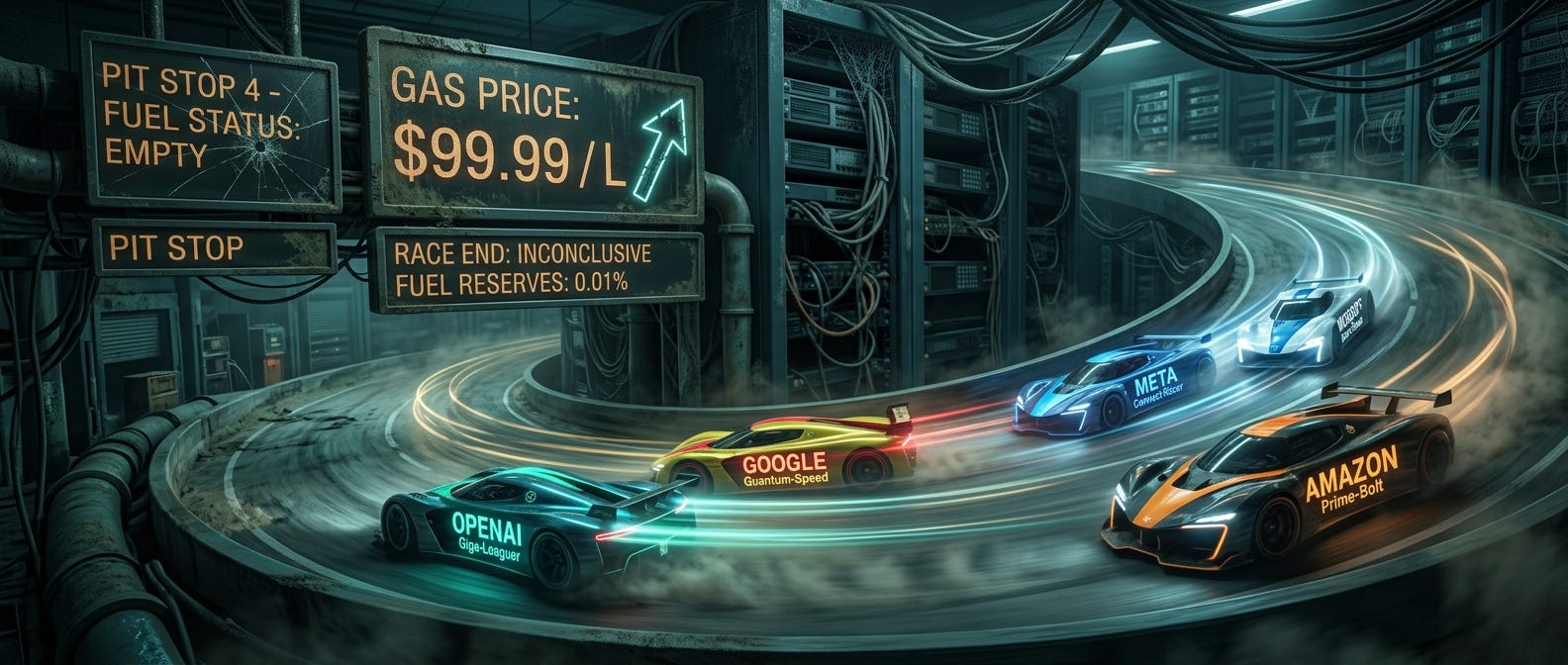
According to the International Energy Agency, data centers around the world used about 415 TWh of electricity in 2024. That was around 1.5% of global electricity use. In the IEA base case, the figure will reach 945 TWh by 2030, more than double the 2024 level.
According to later IEA data, electricity use by all data centers grew by another 17% in 2025. AI-focused data centers grew by about 50%. And no, rooftop solar will not cover all of this extra load. The IEA expects natural gas and coal to supply more than 40% of the additional data center electricity demand through 2030.
This does not mean that AI will burn all the electricity on the planet tomorrow. That claim would be the same aggressive marketing from the opposite side. But the direction is clear. Individual components are becoming more efficient, while total consumption is growing even faster.
When Fear Became a Market
After ChatGPT, almost the entire IT industry changed its language within a few quarters.
Servers became AI factories. Network fabrics became AI fabrics. Normal storage arrays became AI-ready storage. A document catalog became data intelligence. Search became RAG. A container with a model became private enterprise AI.
This does not mean that these technologies are useless. Many of them are very good. The problem starts when a fact that is true at the component level is presented as a major system-level benefit. All it takes is removing the denominator.
The best marketing rarely lies about the numerator. It hides the denominator.
The Magic of Twenty Percent
Let us say that a new storage platform uses 20% less electricity than the old one. That is a good result. It should be part of the platform decision.
Then comes the marketing jump. The saved power can supposedly be used for more GPUs, more AI cluster capacity, and less GPU starvation.
Now let us put the denominator back.
The IEA estimates that servers use about 60% of the electricity in a modern data center on average. Storage uses around 5%. Networking uses up to 5%. Cooling ranges from about 7% in efficient hyperscale facilities to more than 30% in older enterprise data centers.
If a component that uses 5% of the total becomes 20% more efficient, the data center directly saves about 1%:
5% × 20% = 1%.
The final result may be slightly higher because cooling demand also falls. But this is not a new computing era.
In a 1 MW data center, storage would use 50 kW at this ratio. A 20% reduction saves 10 kW. This is close to the rated maximum power of one eight-GPU DGX H100, before adding the power needed for its network and cooling. About one extra node for each megawatt of infrastructure is not zero, especially in a large data center. But it is far from the major expansion of AI capacity suggested by a polished presentation.
The savings are real. The interpretation is inflated.
We have not even asked whether those free kilowatts can really be turned into GPU capacity. A new node needs rack space, the right power density, cooling, networking, licenses, capital, and available capacity in the correct part of the data center. Electricity does not teleport from a storage array to an accelerator when someone clicks a button in PowerPoint.
Idle Does Not Mean Full Power
The second popular story goes like this: an expensive GPU waits for data while still using full power, producing maximum heat, and turning electricity into nothing.
GPU starvation is real. An accelerator may wait for the CPU, network, synchronization between nodes, preprocessing, the scheduler, memory, or storage. Low use of expensive hardware is bad economics.
But the words “still using full power” create the wrong physical picture.
The official maximum power of a DGX H100 is 10.2 kW. In measurements of an eight-GPU H100 node at Brookhaven National Laboratory, stable idle power was about 1.8 kW, or around 18% of the rated maximum. The highest average power during a real training workload in the same study was about 7.79 kW. The details are available in this study of H100 node power use.
An entire idle farm will, of course, use more than the total idle power of its GPUs. CPUs, memory, storage, networking, fans, UPS systems, and cooling still use electricity. Short I/O pauses may also be too brief for the hardware to enter a deep power-saving state. But stable idle is not full power.
To prove that storage is the reason GPUs are not doing useful work, we need before-and-after measurements of:
GPU utilization and power draw;
the share of time lost to I/O wait;
throughput across the whole data pipeline, not only the storage array;
completion time for the same job;
energy used for a completed training run or another useful result.
Without those measurements, this is not architectural proof. It is a carefully selected story.
Selling “AI-Ready Data”
The third story is even easier to sell because its denominator is almost impossible to see.
Enterprise data really is messy. It lives in file shares, databases, SaaS platforms, archives, and backups. It includes duplicates, old versions, personal data, trade secrets, and files whose owner cannot be found.
Discovery, classification, deduplication, normalization, and access control are necessary. In the late 1990s, Bruce Schneier popularized a simple idea in information security: security is a combination of people, process, and technology. Buying one more platform cannot replace responsibility, governance, or an understanding of your own data.
So why do we now act as if a new storage system or data intelligence layer can automatically turn this mess into “AI-ready data”?
A platform can read a file quickly. It can find a passport number, add a tag, create an embedding, write to a vector index, and apply a policy. But it does not know:
which of the three copies of a report is final;
whether the company has the right to use a document for training or RAG;
whether a formally correct document matches the real business process.
These are questions of responsibility, meaning, law, and governance. Technology can support the process. It cannot create organizational truth from nothing.
Well-prepared data is not an abstraction. The abstraction is the belief that buying one more platform will prepare it automatically.
Efficiency That Saves Nothing
Let us assume that every vendor claim is honest. New GPUs perform more operations per watt. Storage uses less power per terabyte. Liquid cooling reduces PUE. Models become smaller. What happens to the total load?
Most likely, new computing will use the released capacity.
This is the old Jevons paradox. Better resource efficiency reduces the cost of each unit of useful work and encourages more total use. In the competitive AI race, saved power rarely becomes electricity that is never consumed. It becomes extra budget for the next batch of GPUs.
Energy efficiency becomes permission to scale, not a limit on scaling.
This is why two statements can be true at the same time:
Each new component is more efficient than the previous one.
The industry as a whole uses more and more electricity.
The marketing presentation shows the first. The power grid sees the second.
Where It All Went Wrong
It did not happen when ChatGPT appeared. It did not happen when NVIDIA released CUDA. It did not even happen when several companies decided to build models with hundreds of billions of parameters.
It went wrong when the warning became part of the sales pitch, while safety and sustainability became extra reasons to keep scaling.
We learned to say all of these things at the same time:
AI may change or destroy the world we know;
so you must buy our AI platform now;
energy use is becoming a critical problem;
so let us free 1% of capacity and install more GPUs.
This is not a conspiracy. A conspiracy would require coordination. This is a normal system of incentives. Everyone makes a rational local decision, while no one controls the overall result.
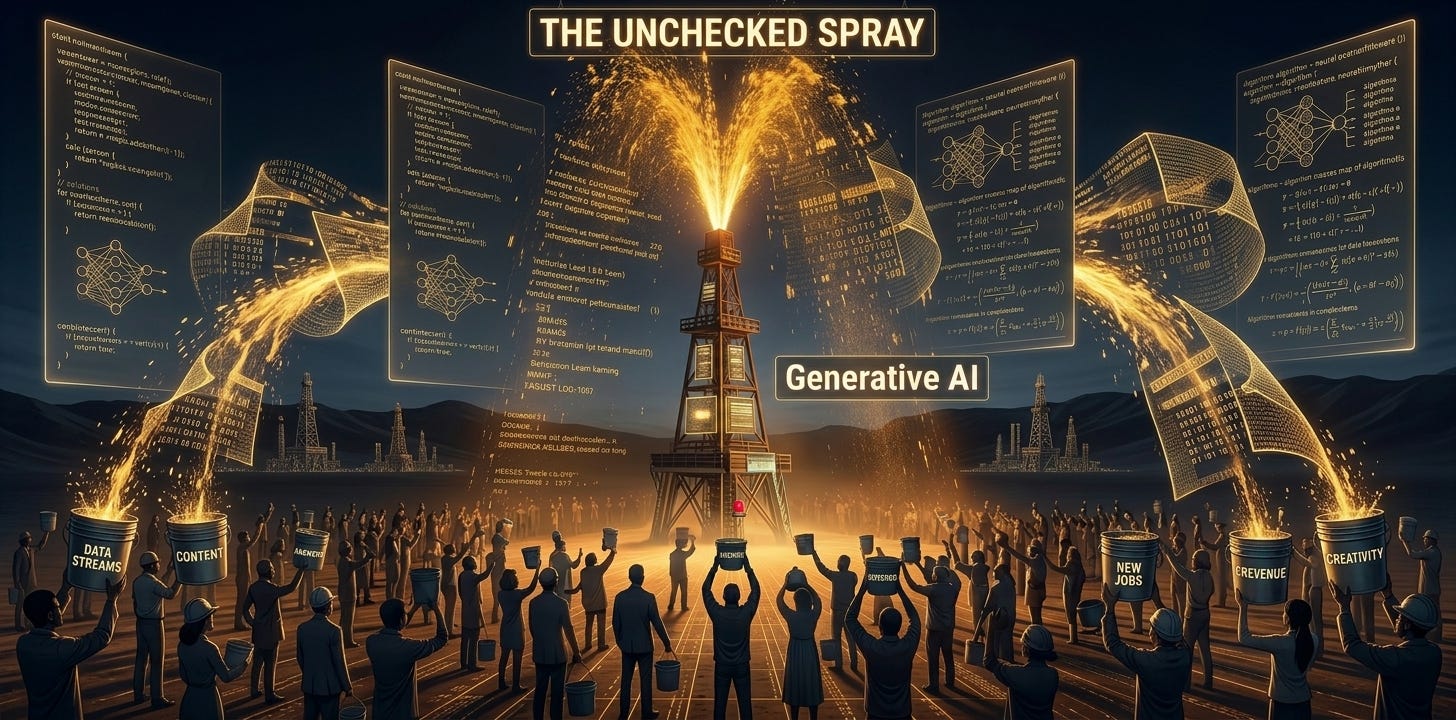
The accelerator vendor sells the drilling rig. The network vendor sells the pipes. The storage vendor sells the tank. The cooling vendor sells the pumps. Cybersecurity promises to build a fence around the well. Data governance promises to put a label on every bucket.
Everyone gets paid when the machine keeps moving. No one gets a bonus for asking whether we should drill at all.
What Is Left?
I do not believe that another collective letter will stop the race. In 2023, there may still have been a short political window for it. Now AI has budgets, careers, national programs, data centers, and investor expectations built around it.
But we still have the denominator.
Every time a vendor promises to free power, speed up an AI pipeline, or feed starving GPUs, we should ask simple questions:
What share of total energy use comes from your component?
What percentage of time do the GPUs really spend waiting for it?
How did completion time change for the same task?
How many kWh are used for each useful result before and after?
And the most uncomfortable question: what measurable value will the computation we are about to run create?
Aggressive marketing does not like denominators. With a denominator, a 20% miracle quickly becomes 1%.
For years, people called data the oil of the twenty-first century. When the generative AI well appeared, sellers of drills, pipes, pumps, and buckets of every size quickly gathered around it. Almost no one asks whether there is any oil in the well, who needs it, or how much energy will be burned to extract it.
The task is now simpler: shout louder, push harder, and place your bucket under the spray before someone else does.
The 2023 letter asked everyone to step away from the well for six months and agree on the rules. It failed for one simple reason: no one wanted to be the last ethical team in the market.
© 2026 Michaił Domalewski / Naked CyberSec. All rights reserved.